

Eutrophication Is Caused By _______.

Eutrophication is the process by which an entire body of h2o, or parts of information technology, becomes progressively enriched with minerals and nutrients, particularly nitrogen and phosphorus. Information technology has also been defined as "nutrient-induced increase in phytoplankton productivity".[1] : 459 H2o bodies with very depression food levels are termed oligotrophic and those with moderate nutrient levels are termed mesotrophic. Advanced eutrophication may also exist referred to as dystrophic and hypertrophic conditions.[2] Eutrophication can affect freshwater or salt water systems. In freshwater ecosystems it is virtually e'er caused by backlog phosphorus.[3] In coastal waters on the other hand, the main contributing nutrient is more likely to be nitrogen, or nitrogen and phosphorus together. This depends on the location and other factors.[4] [5]
When occurring naturally, eutrophication is a very slow process in which nutrients, peculiarly phosphorus compounds and organic thing, accumulate in water bodies.[vi] These nutrients derive from degradation and solution of minerals in rocks and past the effect of lichens, mosses and fungi actively scavenging nutrients from rocks.[7] Anthropogenic or "cultural eutrophication" is oftentimes a much more rapid process in which nutrients are added to a water body from a wide variety of polluting inputs including untreated or partially treated sewage, industrial wastewater and fertilizer from farming practices. Nutrient pollution, a form of water pollution, is a principal cause of eutrophication of surface waters, in which excess nutrients, unremarkably nitrogen or phosphorus, stimulate algal and aquatic constitute growth.
A mutual visible effect of eutrophication is algal blooms. Algal blooms can either be only a nuisance to those wanting to use the water body or become harmful algal blooms that can cause substantial ecological deposition in water bodies.[8] This process may result in oxygen depletion of the water torso after the bacterial degradation of the algae.[9]
Approaches for prevention and reversal of eutrophication include: minimizing signal source pollution from sewage, and minimizing nutrient pollution from agronomics and other nonpoint pollution sources. Shellfish in estuaries, seaweed farming and geo-technology in lakes are also existence used, some at the experimental stage. It is important to note that the term eutrophication is widely used by both scientists and public policy-makers, giving it a myriad of definitions.
Causes and mechanisms [edit]

1. Excess nutrients are practical to the soil. two. Some nutrients leach into the soil and later drain into surface water. 3. Some nutrients run off over the ground into the trunk of water. iv. The backlog nutrients cause an algal bloom. 5. The algal blossom reduces light penetration. six. The plants beneath the algal bloom die because they cannot go sunlight to perform photosynthesis. seven. Somewhen, the algal bloom dies and sinks to the lesser of the lake. Bacterial communities begin to decompose the remains, using up oxygen for respiration. 8. The decomposition causes the water to become depleted of oxygen if the water body is non regularly mixed vertically. Larger life forms, such as fish die.
Increasing biomass generation [edit]
Eutrophication is a process of increasing biomass generation in a water torso caused by increasing concentrations of constitute nutrients, most commonly phosphate and nitrate.[nine] Increasing nutrient concentrations pb to increasing growth of aquatic plants, both macrophytes and phytoplankton.[three] As more plant material becomes available every bit a food resource, there are associated increases in invertebrates and fish species. As the process continues, the biomass of the h2o torso increases and biological diversity decreases.[10] With more severe eutrophication, bacterial degradation of the excess biomass results in oxygen consumption, which can create a country of hypoxia, beginning in the bottom sediment and deeper waters. Hypoxic zones are commonly found in deep water lakes in the summer flavor due to stratification into the cold oxygen-poor hypolimnion and the warm oxygen-rich epilimnion.
Strongly eutrophic freshwaters tin can go hypoxic throughout their depth following astringent algal blooms or macrophyte overgrowths. Similarly in marine systems, both increasing nutrient concentrations and isolation of bodies of water from contact with the temper, can lead to depletion of oxygen which tin make these waters inhospitable to fish and invertebrates.[11]
Phosphorus is a necessary nutrient for plants to live, and is the limiting factor for plant growth in about freshwater ecosystems.[12] Phosphate adheres tightly to soil particles, so information technology is mainly transported by erosion and runoff. Once translocated to lakes, the extraction of phosphate into water is tedious, hence the difficulty of reversing the effects of eutrophication.[thirteen]
In marine ecosystems nitrogen and iron are the chief limiting nutrients for the accumulation of algal biomass,[fourteen] just more generally in marine systems nitrogen, phosphorus and iron can all be limiting.[15] The limitation of productivity in any item aquatic system at any in one case varies with the rate of supply of nutrients from external sources as well as nutrient recycling within the water body. Nutrient limitation of productivity also depends on the rate at which nutrients and algae are physically flushed out of that organization or region. In add-on light is an essential factor so productivity volition be low at depth and in temperate winter when calorie-free levels are low.[fifteen]
Sources of nutrients [edit]
The sources of excess phosphate are phosphates in detergent, industrial/domestic run-offs, and fertilizers. With the phasing out of phosphate-containing detergents in the 1970s, industrial/domestic run-off, sewage and agriculture take emerged every bit the dominant contributors to eutrophication.[16] The main sources of nitrogen beside natural nitrogen fixation are from agricultural runoff (from fertilizers and fauna wastes), from sewage and from atmospheric deposition of nitrogen originating from combustion or animal waste.[17]
Sources of anthropogenic nutrient pollution [edit]
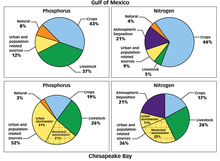
Agriculture is the major source of nutrient pollution in the Gulf of Mexico. In the Chesapeake Bay, agriculture is a major source, along with urban areas and atmospheric deposition.
| Food types | Eutrophying emissions (yard PO4 3-eq per 100g protein) |
|---|---|
| Beef | 365.3 |
| Farmed fish | 235.1 |
| Farmed crustaceans | 227.2 |
| Cheese | 98.4 |
| Lamb and mutton | 97.1 |
| Pork | 76.4 |
| Poultry | 48.7 |
| Eggs | 21.8 |
| Groundnuts | 14.1 |
| Peas | 7.5 |
| Tofu | 6.2 |

An example in Tennessee of how soil from fertilized fields can quickly turn into runoff creating a flux of nutrients that flows into a local h2o body.
The principal source(s) of food pollution in an private watershed depend on the prevailing country uses. The sources may be betoken sources, nonpoint sources, or both:
- Agronomics: creature production or crops
- Urban/suburban: stormwater runoff from roads and parking lots; excessive fertilizer use on lawns; municipal sewage treatment plants; motor vehicle emissions
- Industrial: air pollution emissions (e.g. electric power plants), wastewater discharges from various industries.[19]
Nutrient pollution from some air pollution sources may occur independently of the local country uses, due to long-range transport of air pollutants from distant sources.[20]
In order to gauge how to best prevent eutrophication from occurring, specific sources that contribute to food loading must be identified. There are 2 common sources of nutrients and organic matter: indicate and nonpoint sources.

Sodium triphosphate, once a component of many detergents, was a major contributor to eutrophication.
Types [edit]
Cultural eutrophication [edit]

Cultural eutrophication is caused past human additions of nutrients into the water that crusade over growth of algae which can cake light and air exchange. The algae eventually are cleaved down by leaner causing anoxic weather and "dead zones".
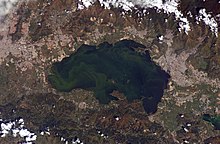
Aerial view of Lake Valencia experiencing a big cultural eutrophication flux due to untreated wastewater discharging into the lake
Cultural or anthropogenic eutrophication is the process that speeds up natural eutrophication because of human activity.[21] Due to clearing of country and edifice of towns and cities, land runoff is accelerated and more nutrients such as phosphates and nitrate are supplied to lakes and rivers, and then to littoral estuaries and bays. Cultural eutrophication results when excessive nutrients from human activities cease up in water bodies creating food pollution and besides accelerating the natural process of eutrophication.[21] The problem became more credible following the introduction of chemic fertilizers in agriculture (green revolution of the mid-1900s).[22] Phosphorus and nitrogen are the 2 main nutrients that cause cultural eutrophication as they enrich the water, allowing for some aquatic plants, especially algae to grow rapidly and bloom in high densities. Algal blooms can shade out benthic plants thereby altering the overall institute community.[23] When algae die off, their degradation by bacteria removes oxygen, potentially, generating anoxic weather condition. This anoxic surround kills off aerobic organisms (eastward.g. fish and invertebrates) in the h2o body. This also affects terrestrial animals, restricting their access to affected water (eastward.chiliad. every bit drinking sources). Selection for algal and aquatic plant species that can thrive in nutrient-rich conditions can cause structural and functional disruption to entire aquatic ecosystems and their food webs, resulting in loss of habitat and species biodiversity.[24]
There are several sources of excessive nutrients from human activeness including run-off from fertilized fields, lawns and golf courses, untreated sewage and wastewater and internal combustion of fuels creating nitrogen pollution.[3] Cultural eutrophication tin occur in fresh h2o and salt water bodies, shallow waters being the almost susceptible. In shore lines and shallow lakes, sediments are often resuspended past current of air and waves which tin can result in nutrient release from sediments into the overlying water, enhancing eutrophication.[25] The deterioration of h2o quality acquired past cultural eutrophication can therefore negatively impact homo uses including potable supply for consumption, industrial uses and recreation.[26]
Natural eutrophication [edit]
Although eutrophication is commonly caused past human activities, it can also be a natural process, particularly in lakes. Paleolimnologists now recognise that climatic change, geology, and other external influences are also disquisitional in regulating the natural productivity of lakes. A few lakes also demonstrate the contrary process (meiotrophication[27]), condign less food rich with fourth dimension as food poor inputs slowly elute the nutrient richer water mass of the lake.[28] [29] This process may be seen in artificial lakes and reservoirs which tend to exist highly eutrophic on first filling but may get more oligotrophic with time. The primary difference between natural and anthropogenic eutrophication is that the natural procedure is very slow, occurring on geological fourth dimension scales.[xxx]
Furnishings [edit]

Eutrophication is apparent as increased turbidity in the northern part of the Caspian Sea, imaged from orbit.
Ecological effects [edit]
Eutrophication can have the following ecological effects: increased biomass of phytoplankton, changes in macrophyte species composition and biomass, dissolved oxygen depletion, increased incidences of fish kills, loss of desirable fish species.
Decreased biodiversity [edit]
When an ecosystem experiences an increase in nutrients, primary producers reap the benefits first. In aquatic ecosystems, species such every bit algae experience a population increment (called an algal blossom). Algal blooms limit the sunlight bachelor to bottom-domicile organisms and cause wide swings in the corporeality of dissolved oxygen in the water. Oxygen is required by all aerobically respiring plants and animals and it is replenished in daylight past photosynthesizing plants and algae. Nether eutrophic conditions, dissolved oxygen profoundly increases during the day, but is profoundly reduced after dark by the respiring algae and by microorganisms that feed on the increasing mass of dead algae. When dissolved oxygen levels decline to hypoxic levels, fish and other marine animals suffocate. As a result, creatures such equally fish, shrimp, and particularly immobile lesser dwellers die off.[31] In farthermost cases, anaerobic conditions ensue, promoting growth of leaner. Zones where this occurs are known as expressionless zones.
New species invasion [edit]
Eutrophication may crusade competitive release past making abundant a normally limiting nutrient. This process causes shifts in the species composition of ecosystems. For case, an increase in nitrogen might allow new, competitive species to invade and out-compete original inhabitant species. This has been shown to occur in New England salt marshes.[32] In Europe and Asia, the common bother ofttimes lives in naturally eutrophic or hypereutrophic areas, and is adapted to living in such conditions. The eutrophication of areas outside its natural range partially explicate the fish'due south success in colonizing these areas subsequently being introduced.
Toxicity [edit]
Some harmful algal blooms resulting from eutrophication, are toxic to plants and animals. Toxic compounds tin can make their way up the food chain, resulting in creature mortality.[33] Freshwater algal blooms tin pose a threat to livestock. When the algae dice or are eaten, neuro- and hepatotoxins are released which can kill animals and may pose a threat to humans.[34] [35] An example of algal toxins working their way into humans is the case of shellfish poisoning.[36] Biotoxins created during algal blooms are taken up by shellfish (mussels, oysters), leading to these human foods acquiring the toxicity and poisoning humans. Examples include paralytic, neurotoxic, and diarrhoetic shellfish poisoning. Other marine animals tin can be vectors for such toxins, as in the case of ciguatera, where information technology is typically a predator fish that accumulates the toxin and and so poisons humans.
Economic effects [edit]
Eutrophication and harmful algal blooms tin accept economic impacts due to increasing water treatment costs, commercial line-fishing and shellfish losses, recreational line-fishing losses (reductions in harvestable fish and shellfish), and reduced tourism income (decreases in perceived aesthetic value of the water body).[37] Water treatment costs can be increased due to decreases in water transparency (increased turbidity). There can besides be problems with color and aroma during drinking h2o treatment.
Wellness impacts [edit]
Homo health effects include excess nitrate in drinking water (blueish baby syndrome); disinfection by-products in drinking water.[38] Swimming in h2o affected by a harmful algal bloom tin cause cause skin rashes and respiratory problems.[39]
Causes and effects for unlike types of water bodies [edit]
Freshwater systems [edit]
1 response to added amounts of nutrients in aquatic ecosystems is the rapid growth of microscopic algae, creating an algal flower. In freshwater ecosystems, the formation of floating algal blooms are normally nitrogen-fixing cyanobacteria (blue-green algae). This result is favored when soluble nitrogen becomes limiting and phosphorus inputs remain pregnant.[40] Food pollution is a major cause of algal blooms and excess growth of other aquatic plants leading to overcrowding contest for sunlight, space, and oxygen. Increased competition for the added nutrients tin cause potential disruption to entire ecosystems and food webs, likewise as a loss of habitat, and biodiversity of species.[24]
When macrophytes and algae dice in over-productive eutrophic lakes, rivers and streams, they decompose and the nutrients contained in that organic matter are converted into inorganic form by microorganisms. This decomposition process consumes oxygen, which reduces the concentration of dissolved oxygen. The depleted oxygen levels in turn may lead to fish kills and a range of other furnishings reducing biodiversity. Nutrients may become concentrated in an anoxic zone, oft in deeper waters cut off past stratification of the water cavalcade and may but be made available again during fall plow-over in temperate areas or in conditions of turbulent flow. The expressionless algae and organic load carried past the h2o inflows into a lake settle to the bottom and undergo anaerobic digestion releasing greenhouse gases such as methane and COtwo. Some of the methane gas may exist oxidised by anaerobic methane oxidation bacteria such as Methylococcus capsulatus, which in turn may provide a nutrient source for zooplankton.[41] Thus a cocky-sustaining biological procedure can take identify to generate primary food source for the phytoplankton and zooplankton depending on the availability of adequate dissolved oxygen in the water body.[42]
Enhanced growth of aquatic vegetation, phytoplankton and algal blooms disrupts normal functioning of the ecosystem, causing a variety of bug such every bit a lack of oxygen which is needed for fish and shellfish to survive. The growth of dense algae in surface waters can shade the deeper water and reduce the viability of benthic shelter plants with resultant impacts on the wider ecosystem.[23] [43] Eutrophication also decreases the value of rivers, lakes and aesthetic enjoyment. Wellness bug tin occur where eutrophic conditions interfere with drinking water treatment.[44]
Phosphorus is often regarded every bit the main culprit in cases of eutrophication in lakes subjected to "indicate source" pollution from sewage pipes. The concentration of algae and the trophic state of lakes correspond well to phosphorus levels in h2o. Studies conducted in the Experimental Lakes Surface area in Ontario have shown a relationship betwixt the add-on of phosphorus and the charge per unit of eutrophication. Afterward stages of eutrophication atomic number 82 to blooms of nitrogen-fixing cyanobacteria limited solely by the phosphorus concentration.[45]
Coastal waters [edit]

Map of measured Gulf hypoxia zone, July 25–31, 2021, LUMCON-NOAA

Oxygen minimum zones (OMZs) (bluish) and areas with coastal hypoxia (red) in the earth's ocean[11]
Eutrophication is a mutual phenomenon in coastal waters. In coastal waters, nitrogen is commonly the key limiting nutrient of marine waters (unlike the freshwater systems where phosphorus is often the limiting nutrient). Therefore, nitrogen levels are more important than phosphorus levels for understanding and controlling eutrophication bug in salt water.[46] Estuaries, equally the interface between freshwater and saltwater, can be both phosphorus and nitrogen limited and commonly showroom symptoms of eutrophication. Eutrophication in estuaries ofttimes results in bottom water hypoxia or anoxia, leading to fish kills and habitat deposition.[47] Upwelling in coastal systems as well promotes increased productivity by conveying deep, nutrient-rich waters to the surface, where the nutrients tin be assimilated by algae.
Examples of anthropogenic sources of nitrogen-rich pollution to coastal waters include body of water cage fish farming and discharges of ammonia from the production of coke from coal.[48] In addition to runoff from state, wastes from fish farming and industrial ammonia discharges, atmospheric fixed nitrogen can exist an of import nutrient source in the open body of water. This could account for effectually one tertiary of the sea's external (non-recycled) nitrogen supply, and up to 3% of the annual new marine biological product.[49]
Coastal waters embrace a wide range of marine habitats from enclosed estuaries to the open waters of the continental shelf. Phytoplankton productivity in coastal waters depends on both nutrient and light supply, with the latter an important limiting cistron in waters near to shore where sediment resuspension frequently limits light penetration.
Nutrients are supplied to coastal waters from state via river and groundwater and also via the atmosphere. There is also an important source from the open up ocean, via mixing of relatively food rich deep body of water waters.[l] Nutrient inputs from the ocean are little changed by human activeness, although climate change may modify the h2o flows beyond the shelf break. By contrast, inputs from land to coastal zones of the nutrients nitrogen and phosphorus have been increased by homo activity globally. The extent of increases varies greatly from identify to place depending on human activities in the catchments.[51] [52] A third key nutrient, dissolved silicon, is derived primarily from sediment weathering to rivers and from offshore and is therefore much less affected by human activity.
Effects of coastal eutrophication [edit]
These increasing nitrogen and phosphorus nutrient inputs exert eutrophication pressures on coastal zones. These pressures vary geographically depending on the catchment activities and associated nutrient load. The geographical setting of the littoral zone is some other important factor equally it controls dilution of the nutrient load and oxygen substitution with the atmosphere. The effects of these eutrophication pressures can exist seen in several dissimilar ways:
- There is evidence from satellite monitoring that the amounts of chlorophyll as a measure of overall phytoplankton activity are increasing in many coastal areas worldwide due to increased food inputs.[53]
- The phytoplankton species composition may change due to increased nutrient loadings and changes in the proportions of primal nutrients. In particular the increases in nitrogen and phosphorus inputs, along with much smaller changes in silicon inputs, create changes in the ratio of nitrogen and phosphorus to silicon. These changing nutrient ratios drive changes in phytoplankton species limerick, particularly disadvantaging silica rich phytoplankton species similar diatoms compared to other species.[50] This process leads to the development of nuisance algal blooms in areas such as the Northward Sea[54] (run across likewise OSPAR Convention) and the Blackness Body of water.[55] In some cases nutrient enrichment can lead to harmful algal blooms (HABs). Such blooms tin can occur naturally, simply there is adept evidence that these are increasing equally a issue of nutrient enrichment, although the causal linkage between nutrient enrichment and HABs is not straightforward.[viii]
- Oxygen depletion has existed in some coastal seas such as the Baltic for thousands of years. In such areas the density structure of the water column severely restricts water column mixing and associated oxygenation of deep water. However, increases in the inputs of bacterially degradable organic thing to such isolated deep waters can exacerbate such oxygen depletion in oceans. These areas of lower dissolved oxygen take increased globally in recent decades. They are normally connected with nutrient enrichment and resulting algal blooms.[11] Climate change will generally tend to increase water column stratification and and so exacerbate this oxygen depletion problem.[56] An example of such littoral oxygen depletion is in the Gulf of Mexico where an area of seasonal anoxia more than 5000 square miles in area has developed since the 1950s. The increased main production driving this anoxia is fueled past nutrients supplied by the Mississippi river.[57] A similar process has been documented in the Black Sea.[55]
Extent of the problem [edit]
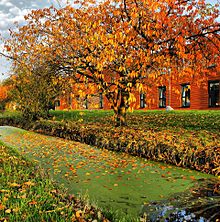
Eutrophication in a canal
Surveys showed that 54% of lakes in Asia are eutrophic; in Europe, 53%; in North America, 48%; in S America, 41%; and in Africa, 28%.[58] In South Africa, a study by the CSIR using remote sensing has shown more than than 60% of the reservoirs surveyed were eutrophic.[59]
The World Resources Institute has identified 375 hypoxic littoral zones in the world, concentrated in coastal areas in Western Europe, the Eastern and Southern coasts of the US, and East asia, particularly Japan.[lx]
Global goals [edit]
The Un framework for Sustainable Development Goals recognizes the dissentious effects of eutrophication for marine environments. It has established a timeline for creating an Index of Coastal Eutrophication and Floating Plastic Droppings Density (ICEP) within Sustainable Evolution Goal 14 (life below h2o).[61] SDG xiv specifically has a target to: "by 2025, prevent and significantly reduce marine pollution of all kinds, in particular from state-based activities, including marine droppings and food pollution".[62]
Prevention [edit]

Minimizing point source pollution from sewage [edit]
Finnish phosphorus removal measures started in the mid-1970s and accept targeted rivers and lakes polluted by industrial and municipal discharges. These efforts have had a ninety% removal efficiency.[63] Even so, some targeted point sources did non show a subtract in runoff despite reduction efforts.
In that location are multiple unlike ways to fix cultural eutrophication with raw sewage being a signal source of pollution. For example, sewage treatment plants can be upgraded for biological nutrient removal and then that they discharge much less nitrogen and phosphorus to the receiving h2o trunk. Still, even with skillful secondary treatment, most final effluents from sewage treatment works contain substantial concentrations of nitrogen every bit nitrate, nitrite or ammonia. Removal of these nutrients is an expensive and often difficult process.
Laws regulating the discharge and treatment of sewage have led to dramatic nutrient reductions to surrounding ecosystems.[10] Because a major contributor to the nonpoint source food loading of water bodies is untreated domestic sewage, it is necessary to provide handling facilities to highly urbanized areas, especially those in developing countries, in which treatment of domestic waste water is a scarcity. The technology to safely and efficiently reuse wastewater, both from domestic and industrial sources, should be a primary business concern for policy regarding eutrophication.
Minimizing nutrient pollution by agronomics [edit]
There are many means to assistance fix cultural eutrophication caused past agriculture. Safe farming practices is the number one style to set up the trouble. Some prophylactic precautions are:[64]
- Nutrient Management Techniques - Anyone using fertilizers should employ fertilizer in the right amount, at the right fourth dimension of year, with the right method and placement.
- Year - Circular Ground Cover - a cover crop will prevent periods of bare ground thus eliminating erosion and runoff of nutrients even after the growing season has occurred.
- Planting Field Buffers - By planting copse, shrubs and grasses along the edges of fields to help grab the runoff and blot some nutrients before the water makes it to a nearby h2o torso.
- Conservation Tillage - By reducing frequency and intensity of tilling the land volition heighten the chance of nutrients absorbing into the ground.
Minimizing nonpoint pollution [edit]
Nonpoint pollution is the most difficult source of nutrients to manage. The literature suggests, though, that when these sources are controlled, eutrophication decreases. The following steps are recommended to minimize the amount of pollution that tin can enter aquatic ecosystems from ambiguous sources.
Riparian buffer zones [edit]
Studies show that intercepting non-point pollution between the source and the h2o is a successful ways of prevention.[65] Riparian buffer zones are interfaces between a flowing trunk of water and state, and have been created almost waterways in an attempt to filter pollutants; sediment and nutrients are deposited hither instead of in h2o. Creating buffer zones nearly farms and roads is some other possible manner to prevent nutrients from traveling as well far. Still, studies have shown[66] that the effects of atmospheric nitrogen pollution tin can accomplish far past the buffer zone. This suggests that the most effective means of prevention is from the principal source.
Prevention policy [edit]
A policy regulating agricultural apply of fertilizer and animal waste must be imposed. In Nippon the amount of nitrogen produced by livestock is adequate to serve the fertilizer needs for the agriculture industry.[67] Thus, it is not unreasonable to command livestock owners to collect beast waste from the field, which when left stagnant will leach into footing water.
Policy concerning the prevention and reduction of eutrophication tin can be broken down into four sectors: Technologies, public participation, economical instruments, and cooperation.[68] The term applied science is used loosely, referring to a more widespread employ of existing methods rather than an appropriation of new technologies. As mentioned before, nonpoint sources of pollution are the chief contributors to eutrophication, and their effects can be hands minimized through common agricultural practices. Reducing the amount of pollutants that reach a watershed can be achieved through the protection of its forest cover, reducing the amount of erosion leeching into a watershed. Too, through the efficient, controlled use of land using sustainable agricultural practices to minimize land degradation, the amount of soil runoff and nitrogen-based fertilizers reaching a watershed can be reduced.[69] Waste disposal engineering constitutes another gene in eutrophication prevention.
The function of the public is a major factor for the constructive prevention of eutrophication. In society for a policy to have whatever effect, the public must be aware of their contribution to the problem, and ways in which they can reduce their effects. Programs instituted to promote participation in the recycling and emptying of wastes, as well as education on the issue of rational water use are necessary to protect h2o quality within urbanized areas and next h2o bodies.
Economic instruments, "which include, amid others, holding rights, water markets, fiscal and financial instruments, charge systems and liability systems, are gradually becoming a substantive component of the management tool set used for pollution control and h2o allocation decisions."[68] Incentives for those who practise clean, renewable, h2o management technologies are an constructive means of encouraging pollution prevention. By internalizing the costs associated with the negative effects on the environment, governments are able to encourage a cleaner water direction.
Because a trunk of water can have an effect on a range of people reaching far across that of the watershed, cooperation betwixt dissimilar organizations is necessary to prevent the intrusion of contaminants that can atomic number 82 to eutrophication. Agencies ranging from state governments to those of water resource management and non-governmental organizations, going as low equally the local population, are responsible for preventing eutrophication of water bodies. In the United States, the most well known inter-country effort to forbid eutrophication is the Chesapeake Bay.[lxx]
Nitrogen testing and modeling [edit]
Soil nitrogen testing (North-Testing) is a technique that helps farmers optimize the amount of fertilizer applied to crops. By testing fields with this method, farmers saw a decrease in fertilizer application costs, a decrease in nitrogen lost to surrounding sources, or both.[71] By testing the soil and modeling the bare minimum amount of fertilizer are needed, farmers reap economic benefits while reducing pollution.
Organic farming [edit]
Organically fertilized fields can "significantly reduce harmful nitrate leaching" compared to conventionally fertilized fields.[72] Eutrophication impacts are in some cases college from organic production than they are from conventional production.[73]
Reversal and remediation [edit]
Recovering from eutrophication [edit]

Mussels are an case of organisms that act equally food bioextractors.
Reducing food inputs is a primal precondition for restoration, merely at that place are two caveats: Firstly it tin can take a long time, particularly because of the storage of nutrients in sediments. Secondly, restoration may demand more than a simple reversal of inputs since there are sometimes several stable but very different ecological states.[74] Recovery of eutrophicated lakes is deadening, often requiring several decades.[12]
Innovative solutions have been conceived to deal with food pollution in aquatic systems by altering or enhancing natural processes to shift nutrient effects away from detrimental ecological impacts.[ citation needed ] Nutrient remediation is a class of ecology remediation, but concerns simply biologically agile nutrients such as nitrogen and phosphorus. "Remediation" refers to the removal of pollution or contaminants, mostly for the protection of human health. In ecology remediation nutrient removal technologies include biofiltration, which uses living material to capture and biologically dethrone pollutants. Examples include green belts, riparian areas, natural and constructed wetlands, and treatment ponds. These areas most normally capture anthropogenic discharges such as wastewater, stormwater runoff, or sewage handling, for land reclamation afterward mining, refinery activity, or state development.[ commendation needed ] Biofiltration utilizes biological assimilation to capture, blot, and eventually incorporate the pollutants (including nutrients) into living tissue. Another form of nutrient removal is bioremediation, which uses microorganisms to remove pollutants. Bioremediation can occur on its own every bit natural attenuation or intrinsic bioremediation or can be encouraged by the addition of fertilizers, a strategy called biostimulation.[ citation needed ]
Nutrient bioextraction is bioremediation involving cultured plants and animals. Nutrient bioextraction or bioharvesting is the practice of farming and harvesting shellfish and seaweed for the purpose of removing nitrogen and other nutrients from natural water bodies.[75] Information technology has been suggested that nitrogen removal past oyster reefs could generate cyberspace benefits for sources facing nitrogen emission restrictions, like to other nutrient trading scenarios. Specifically, if oysters maintain nitrogen levels in estuaries beneath thresholds that would lead to the imposition of emission limits, oysters finer salvage the sources the compliance costs they otherwise would incur.[76] Several studies take shown that oysters and mussels have the capacity to dramatically bear on nitrogen levels in estuaries.[77] [78] [79] Additionally, studies have demonstrated seaweed's potential to improve nitrogen levels.[80]
Shellfish in estuaries [edit]
One proposed solution to stop and opposite eutrophication in estuaries is to restore shellfish populations, such every bit oysters and mussels. Oyster reefs remove nitrogen from the water cavalcade and filter out suspended solids, subsequently reducing the likelihood or extent of harmful algal blooms or anoxic conditions.[81] Filter feeding action is considered benign to water quality[82] by controlling phytoplankton density and sequestering nutrients, which can be removed from the system through shellfish harvest, buried in the sediments, or lost through denitrification.[83] [84] Foundational work toward the idea of improving marine water quality through shellfish cultivation was conducted by Odd Lindahl et al., using mussels in Sweden.[85] In the United States, shellfish restoration projects have been conducted on the East, West and Gulf coasts.[86] Meet nutrient pollution for an extended explanation of nutrient remediation using shellfish.
Seaweed farming [edit]
Seaweed aquaculture offers an opportunity to mitigate, and accommodate to climatic change.[87] Seaweed, such as kelp, besides absorbs phosphorus and nitrogen[88] and is thus useful to remove excessive nutrients from polluted parts of the sea.[89] Some cultivated seaweeds have a very high productivity and could blot big quantities of North, P, CO2, producing large amounts of Oii having an splendid effect on decreasing eutrophication.[90] Information technology is believed that seaweed cultivation in big scale should be a good solution to the eutrophication problem in coastal waters.
Geo-engineering in lakes (chemical phosphorus removal) [edit]
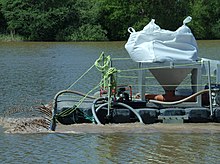
Awarding of a phosphorus sorbent to a lake - The Netherlands
Geo-engineering is the manipulation of biogeochemical processes, usually the phosphorus bike, to attain a desired ecological response in the ecosystem.[91] Geo-engineering techniques typically uses materials able to chemically inactivate the phosphorus bachelor for organisms (i.e. phosphate) in the water cavalcade and as well block the phosphate release from the sediment (internal loading).[92] Phosphate is one of the main contributing factors to algal growth, mainly cyanobacteria, and so once phosphate is reduced the algal is not able to overgrow.[93] Thus, geo-engineering materials is used to speed-up the recovery of eutrophic water bodies and manage algal bloom.[94] There are several phosphate sorbents in the literature, from metallic salts (e.grand. alum, aluminium sulfate,[95]) minerals, natural clays and local soils, industrial waste products, modified clays (due east.1000. lanthanum modified bentonite) and others.[96] [97] The phosphate sorbent is commonly applied in the surface of the water body and information technology sinks to the bottom of the lake reducing phosphate, such sorbents have been applied worldwide to manage eutrophication and algal bloom (for example under the commercial proper name Phoslock).[98] [99] [100] [101]
I method of eutrophication remediation uses chemical phosphorus removal with aluminum sulfate, a salt commonly used in the coagulation process of drinking water treatment. Aluminum sulfate, or "alum" every bit information technology is commonly referred, is used to reduce the phosphorus load.[102] In a large calibration report, 114 lakes were monitored for the effectiveness of alum at phosphorus reduction. Across all lakes, alum finer reduced the phosphorus for 11 years. While there was variety in the longevity (21 years in deep lakes and v.7 years in shallow lakes), the results express the effectiveness of alum at decision-making phosphorus within lakes.[103] Alum treatment is less constructive in deep lakes, as well as lakes with substantial external phosphorus loading.[104]
History [edit]
Eutrophication was recognized as a water pollution problem in European and North American lakes and reservoirs in the mid-20th century.[105] Breakthrough research carried out at the Experimental Lakes Expanse (ELA) in Ontario, Canada in the 1970s [106] provided the evidence that freshwater bodies are phosphorus-limited. ELA uses the whole ecosystem approach and long-term, whole-lake investigations of freshwater focusing on cultural eutrophication.
Terminology [edit]
Etymology [edit]
The term "eutrophication" comes from the Greek eutrophos, significant "well-nourished".[107]
Other uses of the term [edit]
Terrestrial eutrophication [edit]
Whilst eutrophication is unremarkably referring to aquatic systems, some authors have used the term "terrestrial eutrophication" for terrestrial ecosystems.[108] [109] This is defined as "enrichment of an ecosystem with a limiting nutrient" and can be caused past nitrogen deposition on terrestrial ecosystems.[109] For example, atmospheric COii fertilization tin exacerbate the eutrophication of the boreal forest biome.[108]
See also [edit]
- Biogeochemical bicycle – Chemical transfer pathway between Earth's biological and non-biological parts
- Ecological Quality Ratio
- Nitrogen bicycle – Biogeochemical cycle past which nitrogen is converted into diverse chemical forms
- Trophic state alphabetize – Measure of the ability of water to sustain biological productivity
- Upland and lowland (freshwater environmental)
- Water Framework Directive
References [edit]
- ^ Chapin, F. Stuart, III (2011). "Glossary". Principles of terrestrial ecosystem environmental. P. A. Matson, Peter Morrison Vitousek, Melissa C. Chapin (2nd ed.). New York: Springer. ISBN978-1-4419-9504-ix. OCLC 755081405.
- ^ Wetzel, Robert (1975). Limnology. Philadelphia-London-Toronto: W.B. Saunders. p. 743. ISBN0-7216-9240-0.
- ^ a b c Schindler, David W., Vallentyne, John R. (2008). The Algal Bowl: Overfertilization of the World's Freshwaters and Estuaries, University of Alberta Press, ISBN 0-88864-484-i.
- ^ Elser, James J.; Bracken, Matthew East. Due south.; Cleland, Elsa East.; Gruner, Daniel S.; Harpole, Due west. Stanley; Hillebrand, Helmut; Ngai, Jacqueline T.; Seabloom, Eric W.; Shurin, Jonathan B.; Smith, Jennifer E. (2007). "Global analysis of nitrogen and phosphorus limitation of primary producers in freshwater, marine and terrestrial ecosystems". Ecology Messages. 10 (12): 1135–1142. doi:10.1111/j.1461-0248.2007.01113.x. hdl:1903/7447. ISSN 1461-0248. PMID 17922835.
- ^ Le Moal, Morgane; Gascuel-Odoux, Chantal; Ménesguen, Alain; Souchon, Yves; Étrillard, Claire; Levain, Alix; Moatar, Florentina; Pannard, Alexandrine; Souchu, Philippe; Lefebvre, Alain; Pinay, Gilles (15 February 2019). "Eutrophication: A new wine in an sometime canteen?" (PDF). Science of the Total Environment. 651 (Pt 1): 1–xi. Bibcode:2019ScTEn.651....1L. doi:x.1016/j.scitotenv.2018.09.139. PMID 30223216. S2CID 52311511. Archived (PDF) from the original on 4 March 2022. Retrieved 4 March 2022.
- ^ Addy, Kelly (1996). "Phosphorus and Lake Aging" (PDF). Natural Resources Facts - University of Rhode Island. Archived (PDF) from the original on July 28, 2021. Retrieved June sixteen, 2021.
- ^ Clair Northward. Sawyer (May 1966). "Basic Concepts of Eutrophication". Journal (Water Pollution Control Federation). Wiley. 38 (5): 737–744. JSTOR 25035549. Archived from the original on 2021-06-03. Retrieved 2021-02-12 .
- ^ a b Glibert, Patricia; Burford, Michele (2017). "Globally Irresolute Nutrient Loads and Harmful Algal Blooms: Contempo Advances, New Paradigms, and Continuing Challenges". Oceanography. 30 (i): 58–69. doi:ten.5670/oceanog.2017.110. Archived from the original on 2022-01-21. Retrieved 2022-02-09 .
- ^ a b Schindler, David and Vallentyne, John R. (2004) Over fertilization of the World'southward Freshwaters and Estuaries, University of Alberta Printing, p. 1, ISBN 0-88864-484-1
- ^ a b Smith, V. H.; Tilman, Chiliad. D.; Nekola, J. C. (1999). "Eutrophication: Impacts of excess nutrient inputs on freshwater, marine, and terrestrial ecosystems". Environmental Pollution. 100 (ane–3): 179–196. doi:10.1016/S0269-7491(99)00091-3. PMID 15093117.
- ^ a b c Breitburg, Denise; Levin, Lisa A.; Oschlies, Andreas; Grégoire, Marilaure; Chavez, Francisco P.; Conley, Daniel J.; Garçon, Véronique; Gilbert, Denis; Gutiérrez, Dimitri; Isensee, Kirsten; Jacinto, Gil South. (2018). "Declining oxygen in the global ocean and coastal waters". Scientific discipline. 359 (6371). Bibcode:2018Sci...359M7240B. doi:10.1126/scientific discipline.aam7240. PMID 29301986. S2CID 206657115.
- ^ a b Schindler, David W. (2012). "The dilemma of decision-making cultural eutrophication of lakes". Proceedings of the Regal Social club B: Biological Sciences. 279 (1746): 4322–4333. doi:10.1098/rspb.2012.1032. PMC3479793. PMID 22915669.
- ^ Khan, M. Nasir and Mohammad, F. (2014 ) "Eutrophication of Lakes" in A. A. Ansari, Due south. S. Gill (eds.), Eutrophication: Challenges and Solutions; Book 2 of Eutrophication: Causes, Consequences and Command, Springer Science+Business concern Media Dordrecht. doi:10.1007/978-94-007-7814-6_1. ISBN 978-94-007-7814-6.
- ^ Bristow, L.; Mohr, W. (2017). "Nutrients that limit growth in the ocean". Electric current Biology. 27 (11): R431–R510. doi:10.1016/j.cub.2017.03.030. hdl:21.11116/0000-0001-C1AA-5. PMID 28586682. S2CID 21052483. Archived from the original on 2022-09-28. Retrieved 2021-06-17 .
- ^ a b Moore, C. M.; Mills, M. Grand.; Arrigo, Thousand. R.; Berman-Frank, I.; Bopp, Fifty.; Boyd, P. W.; Galbraith, E. D.; Geider, R. J.; Guieu, C.; Jaccard, S. L.; Jickells, T. D. (2013). "Processes and patterns of oceanic food limitation". Nature Geoscience. 6 (9): 701–710. Bibcode:2013NatGe...6..701M. doi:10.1038/ngeo1765. ISSN 1752-0908. Archived from the original on 2022-01-27. Retrieved 2022-02-08 .
- ^ Werner, Wilfried (2002) "Fertilizers, half-dozen. Environmental Aspects". Ullmann's Encyclopedia of Industrial Biology, Wiley-VCH, Weinheim. doi:10.1002/14356007.n10_n05
- ^ Fowler, David; Coyle, Mhairi; Skiba, Ute; Sutton, Mark A.; Greatcoat, J. Neil; Reis, Stefan; Sheppard, Lucy J.; Jenkins, Alan; Grizzetti, Bruna; Galloway, James Due north.; Vitousek, Peter (2013). "The global nitrogen cycle in the twenty-outset century". Philosophical Transactions of the Royal Club B: Biological Sciences. 368 (1621): 20130164. doi:10.1098/rstb.2013.0164. PMC3682748. PMID 23713126.
- ^ Nemecek, T.; Poore, J. (2018-06-01). "Reducing nutrient'south ecology impacts through producers and consumers". Science. 360 (6392): 987–992. Bibcode:2018Sci...360..987P. doi:ten.1126/science.aaq0216. ISSN 0036-8075. PMID 29853680.
- ^ "Sources and Solutions". Nutrient Pollution. EPA. 2021-08-31.
- ^ "The Effects: Environment". Nutrient Pollution. EPA. 2021-03-01.
- ^ a b Cultural eutrophication Archived 2015-05-04 at the Wayback Machine (2010) Encyclopedia Britannica. Retrieved April 26, 2010, from Encyclopedia Britannica Online:
- ^ Smil, Vaclav (November 2000). "Phosphorus in the Surroundings: Natural Flows and Human Interferences". Annual Review of Free energy and the Environment. 25 (i): 53–88. doi:ten.1146/annurev.energy.25.1.53. ISSN 1056-3466.
- ^ a b Moss, Brian (1983). "The Norfolk Broadland: Experiments in the Restoration of a Complex Wetland". Biological Reviews. 58 (four): 521–561. doi:ten.1111/j.1469-185X.1983.tb00399.x. ISSN 1469-185X. S2CID 83803387. Archived from the original on 2022-02-08. Retrieved 2022-02-08 .
- ^ a b Rabalais, NN (Mar 2002). "Nitrogen in aquatic ecosystems". Ambio: A Journal of the Human Environment. 31 (2): 102–112. doi:ten.1579/0044-7447-31.two.102. PMID 12077998. S2CID 19172194.
- ^ Qin, Boqiang; Yang, Liuyan; Chen, Feizhou; Zhu, Guangwei; Zhang, Lu; Chen, Yiyu (2006-10-01). "Mechanism and control of lake eutrophication". Chinese Science Bulletin. 51 (nineteen): 2401–2412. Bibcode:2006ChSBu..51.2401Q. doi:10.1007/s11434-006-2096-y. ISSN 1861-9541. S2CID 198137333.
- ^ Khan, K. Nasir; Mohammad, Firoz (2014), Ansari, Abid A.; Gill, Sarvajeet Singh (eds.), "Eutrophication: Challenges and Solutions", Eutrophication: Causes, Consequences and Control: Volume two, Springer Netherlands, pp. 1–15, doi:10.1007/978-94-007-7814-6_1, ISBN978-94-007-7814-6
- ^ Wetzel, Robert Yard. (2001). Limnology: lake and river ecosystems (third ed.). San Diego: Academic Press. ISBN0-12-744760-one. OCLC 46393244. Archived from the original on 2020-11-02. Retrieved 2022-02-08 .
- ^ Walker, I. R. (2006) "Chironomid overview", pp. 360–366 in Southward.A. EIias (ed.) Encyclopedia of Quaternary Science, Vol. one, Elsevier,
- ^ Whiteside, M. C. (1983). "The mythical concept of eutrophication". Hydrobiologia. 103: 107–150. doi:10.1007/BF00028437. S2CID 19039247.
- ^ Callisto, Marcos; Molozzi, Joseline and Barbosa, José Lucena Etham (2014) "Eutrophication of Lakes" in A. A. Ansari, S. S. Gill (eds.), Eutrophication: Causes, Consequences and Control, Springer Science+Business organisation Media Dordrecht. doi:10.1007/978-94-007-7814-6_5. ISBN 978-94-007-7814-vi.
- ^ Horrigan, L.; Lawrence, R. S.; Walker, P. (2002). "How sustainable agriculture can accost the environmental and human health harms of industrial agronomics". Environmental Health Perspectives. 110 (five): 445–456. doi:ten.1289/ehp.02110445. PMC1240832. PMID 12003747.
- ^ Bertness, Yard. D.; Ewanchuk, P. J.; Silliman, B. R. (2002). "Anthropogenic modification of New England salt marsh landscapes". Proceedings of the National Academy of Sciences of the United States of America. 99 (3): 1395–1398. Bibcode:2002PNAS...99.1395B. doi:10.1073/pnas.022447299. JSTOR 3057772. PMC122201. PMID 11818525.
- ^ Anderson D. Thou. (1994). "Red tides" (PDF). Scientific American. 271 (2): 62–68. Bibcode:1994SciAm.271b..62A. doi:ten.1038/scientificamerican0894-62. PMID 8066432. Archived (PDF) from the original on 2013-05-11. Retrieved 2013-03-31 .
- ^ Lawton, Fifty.A.; Grand.A. Codd (1991). "Cyanobacterial (blue-green algae) toxins and their significance in United kingdom and European waters". Periodical of Soil and H2o Conservation. xl (four): 87–97. doi:10.1111/j.1747-6593.1991.tb00643.x.
- ^ Martin, A.; G.D. Cooke (1994). "Health risks in eutrophic water supplies". Lake Line. 14: 24–26.
- ^ Shumway, South. E. (1990). "A Review of the Effects of Algal Blooms on Shellfish and Aquaculture". Periodical of the Globe Aquaculture Social club. 21 (ii): 65–104. doi:10.1111/j.1749-7345.1990.tb00529.10.
- ^ US EPA, OW (2013). "The Effects: Economy". www.epa.gov. Archived from the original on 2022-09-28. Retrieved 2022-02-15 .
- ^ "The Effects: Human Wellness". Nutrient Pollution. EPA. 2021-03-01. Archived from the original on 2020-02-19. Retrieved 2022-02-21 .
- ^ US EPA, OW (2013). "The Effects: Human Health". world wide web.epa.gov. Archived from the original on 2020-02-19. Retrieved 2022-02-15 .
- ^ Schindler, David West.; Hecky, R.E.; Findlay, D.L.; Stainton, M.P.; Parker, B.R.; Paterson, M.J.; Beaty, K.G.; Lyng, Chiliad.; Kasian, S. E. Chiliad. (August 2008). "Eutrophication of lakes cannot be controlled by reducing nitrogen input: Results of a 37-year whole-ecosystem experiment". Proceedings of the National Academy of Sciences of the U.s.. 105 (32): 11254–11258. doi:10.1073/pnas.0805108105. PMC2491484. PMID 18667696.
- ^ "Climate gases from water bodies". Archived from the original on 2 Feb 2019. Retrieved 22 September 2018.
- ^ "Nature's Value Chain..." (PDF). Archived from the original (PDF) on 21 Dec 2016. Retrieved 22 September 2018.
- ^ Jeppesen, Erik; Søndergaard, Martin; Jensen, Jens Peder; Havens, Karl E.; Anneville, Orlane; Carvalho, Laurence; Coveney, Michael F.; Deneke, Rainer; Dokulil, Martin T.; Foy, Bob; Gerdeaux, Daniel (2005). "Lake responses to reduced food loading – an analysis of contemporary long-term data from 35 instance studies". Freshwater Biology. 50 (10): 1747–1771. doi:10.1111/j.1365-2427.2005.01415.ten. ISSN 1365-2427.
- ^ Bartram, J., Wayne W. Carmichael, Ingrid Chorus, Gary Jones, and Olav One thousand. Skulberg (1999). "Chapter 1. Introduction", in: Toxic Cyanobacteria in Water: A guide to their public wellness consequences, monitoring and direction. World Health Arrangement. URL: WHO document Archived 2007-01-24 at the Wayback Machine
- ^ Higgins, Scott Due north.; Paterson, Michael J.; Hecky, Robert E.; Schindler, David Westward.; Venkiteswaran, Jason J.; Findlay, David L. (27 Nov 2017). "Biological Nitrogen Fixation Prevents the Response of a Eutrophic Lake to Reduced Loading of Nitrogen: Evidence from a 46-Twelvemonth Whole-Lake Experiment". Ecosystems. 21 (six): 1088–1100. doi:10.1007/s10021-017-0204-2. S2CID 26030685.
- ^ Paerl, Hans W.; Valdes, Lexia Chiliad.; Joyner, Alan R.; Piehler, Michael F.; Lebo, Martin E. (2004). "Solving problems resulting from solutions: Development of a dual nutrient direction strategy for the eutrophying Neuse River Estuary, Northward Carolina". Ecology Science and Technology. 38 (11): 3068–3073. Bibcode:2004EnST...38.3068P. doi:ten.1021/es0352350. PMID 15224737.
- ^ Huang, Jing; Xu, Chang-chun; Ridoutt, Bradley; Wang, Xue-chun; Ren, Pin-an (August 2017). "Nitrogen and phosphorus losses and eutrophication potential associated with fertilizer application to cropland in China". Journal of Cleaner Production. 159: 171–179. doi:ten.1016/j.jclepro.2017.05.008.
- ^ "Recovery of Ammonia during Production of Coke from Coking Coal". Ispat Guru. 2019. Archived from the original on June 24, 2021. Retrieved June 17, 2021.
- ^ Duce, R A; et al. (2008). "Impacts of Atmospheric Anthropogenic Nitrogen on the Open Body of water". Science. 320 (5878): 893–89. Bibcode:2008Sci...320..893D. doi:10.1126/science.1150369. hdl:21.11116/0000-0001-CD7A-0. PMID 18487184. S2CID 11204131.
- ^ a b Jickells, T. D. (1998). "Nutrient Biogeochemistry of the Coastal Zone". Science. 281 (5374): 217–222. doi:10.1126/science.281.5374.217. ISSN 0036-8075. PMID 9660744.
- ^ Seitzinger, S. P.; Mayorga, E.; Bouwman, A. F.; Kroeze, C.; Beusen, A. H. W.; Billen, Yard.; Van Drecht, G.; Dumont, E.; Fekete, B. M.; Garnier, J.; Harrison, J. A. (2010). "Global river food consign: A scenario analysis of past and future trends: GLOBAL RIVER Consign SCENARIOS". Global Biogeochemical Cycles. 24 (four): n/a. doi:10.1029/2009GB003587. S2CID 55095122.
- ^ Jickells, T. D.; Buitenhuis, E.; Altieri, K.; Baker, A. R.; Capone, D.; Duce, R. A.; Dentener, F.; Fennel, K.; Kanakidou, Thou.; LaRoche, J.; Lee, K. (2017). "A reevaluation of the magnitude and impacts of anthropogenic atmospheric nitrogen inputs on the body of water: Atmospheric nitrogen inputs". Global Biogeochemical Cycles. doi:x.1002/2016GB005586. hdl:1874/348077. S2CID 5158406.
- ^ Maúre, Elígio de Raús; Terauchi, Genki; Ishizaka, Joji; Clinton, Nicholas; DeWitt, Michael (2021). "Globally consequent assessment of coastal eutrophication". Nature Communications. 12 (i): 6142. doi:10.1038/s41467-021-26391-9. ISSN 2041-1723. PMC8536747. PMID 34686688.
- ^ Ltd, Michael Carder. "Intermediate Cess 2017". oap.ospar.org. Archived from the original on 2022-02-09. Retrieved 2022-02-09 .
- ^ a b Mee, Laurence; Friedrich, Jana; Gomoiu, Marian (2005). "Restoring the Black Sea in Times of Dubiousness". Oceanography. 18 (ii): 100–111. doi:ten.5670/oceanog.2005.45. ISSN 1042-8275. Archived from the original on 2022-09-28. Retrieved 2022-02-09 .
- ^ Li, Guancheng; Cheng, Lijing; Zhu, Jiang; Trenberth, Kevin E.; Mann, Michael Due east.; Abraham, John P. (2020). "Increasing ocean stratification over the by one-half-century". Nature Climate change. 10 (12): 1116–1123. Bibcode:2020NatCC..10.1116L. doi:x.1038/s41558-020-00918-2. ISSN 1758-678X. S2CID 221985871. Archived from the original on 2022-02-eighteen. Retrieved 2022-02-eighteen .
- ^ Rabalais, Nancy N.; Turner, R. Eugene (2019). "Gulf of United mexican states Hypoxia: By, Present, and Hereafter". Limnology and Oceanography Message. 28 (4): 117–124. doi:x.1002/lob.10351. ISSN 1539-6088. S2CID 209578424.
- ^ ILEC/Lake Biwa Research Plant [Eds]. 1988–1993 Survey of the Land of the World'southward Lakes. Volumes I-4. International Lake Surround Commission, Otsu and United nations Environment Programme, Nairobi.
- ^ Matthews, Mark; Bernard, Stewart (2015). "Eutrophication and cyanobacteria in South Africa'southward standing h2o bodies: A view from space". South African Journal of Science. 111 (5/six). doi:10.17159/sajs.2015/20140193.
- ^ Selman, Mindy (2007) Eutrophication: An Overview of Status, Trends, Policies, and Strategies. World Resources Institute.
- ^ "14.one.1 Index of Coastal Eutrophication (ICEP) and Floating Plastic debris Density". UN Environment. Archived from the original on 13 August 2020. Retrieved 14 October 2020.
- ^ "Goal xiv targets". UNDP. Archived from the original on 2020-09-30. Retrieved 2020-09-24 .
- ^ Räike, A.; Pietiläinen, O. -P.; Rekolainen, South.; Kauppila, P.; Pitkänen, H.; Niemi, J.; Raateland, A.; Vuorenmaa, J. (2003). "Trends of phosphorus, nitrogen and chlorophyll a concentrations in Finnish rivers and lakes in 1975–2000". Scientific discipline of the Total Surroundings. 310 (1–iii): 47–59. Bibcode:2003ScTEn.310...47R. doi:ten.1016/S0048-9697(02)00622-8. PMID 12812730.
- ^ "The Sources and Solutions: Agronomics". Us EPA. 2013-03-12. Archived from the original on 2021-06-22.
- ^ Carpenter, S. R.; Caraco, N. F.; Correll, D. Fifty.; Howarth, R. W.; Sharpley, A. North.; Smith, 5. H. (August 1998). "Nonpoint Pollution of Surface Waters with Phosphorus and Nitrogen". Ecological Applications. 8 (three): 559. doi:x.2307/2641247. hdl:1813/60811. JSTOR 2641247.
- ^ Angold P. Thousand. (1997). "The Impact of a Road Upon Adjacent Heathland Vegetation: Furnishings on Plant Species Composition". The Journal of Applied Ecology. 34 (2): 409–417. doi:10.2307/2404886. JSTOR 2404886.
- ^ Kumazawa, Thousand. (2002). "Nitrogen fertilization and nitrate pollution in groundwater in Japan: Present status and measures for sustainable agriculture". Nutrient Cycling in Agroecosystems. 63 (two/three): 129–137. doi:10.1023/A:1021198721003. S2CID 22847510.
- ^ a b "Planning and Management of Lakes and Reservoirs: An Integrated Arroyo to Eutrophication." Archived 2012-11-xi at the Wayback Auto Un Environment Programme, Newsletter and Technical Publications. International Environmental Technology Centre. Ch.three.4 (2000).
- ^ Oglesby, R. T.; Edmondson, W. T. (1966). "Control of Eutrophication". Journal (Water Pollution Command Federation). 38 (9): 1452–1460. JSTOR 25035632.
- ^ Nutrient Limitation. Department of Natural Resources, Maryland, U.S.
- ^ Huang, Wen-Yuan; Lu, Yao-chi; Uri, Noel D. (2001). "An assessment of soil nitrogen testing considering the carry-over effect". Applied Mathematical Modelling. 25 (10): 843–860. doi:10.1016/S0307-904X(98)10001-X. Archived from the original on 2013-04-09. Retrieved 2013-03-31 .
- ^ Kramer, S. B. (2006). "Reduced nitrate leaching and enhanced denitrifier action and efficiency in organically fertilized soils". Proceedings of the National Academy of Sciences. 103 (12): 4522–4527. Bibcode:2006PNAS..103.4522K. doi:10.1073/pnas.0600359103. PMC1450204. PMID 16537377.
- ^ Williams, A.G., Audsley, E. and Sandars, D.L. (2006) Determining the environmental burdens and resource use in the production of agricultural and horticultural bolt Archived 2018-09-25 at the Wayback Machine. Chief Report. Defra Enquiry Project IS0205. Bedford: Cranfield University and Defra.
- ^ May, L; Olszewska, J; Gunn, I D One thousand; Meis, Southward; Spears, B K (2020). "Eutrophication and restoration in temperate lakes". IOP Conference Series: Earth and Environmental Scientific discipline. 535 (1): 012001. Bibcode:2020E&ES..535a2001M. doi:x.1088/1755-1315/535/ane/012001. ISSN 1755-1307. S2CID 225481650.
- ^ "Nutrient Bioextraction Overview". Stamford, CT: Long Island Sound Study partnership. Archived from the original on 2017-ten-06. Retrieved 2018-03-22 .
- ^ Kroeger, Timm (2012). "Dollars and Sense: Economical Benefits and Impacts from two Oyster Reef Restoration Projects in the Northern Gulf of Mexico" (PDF). The Nature Conservancy. Archived from the original (PDF) on 2016-03-04. Retrieved 2013-05-29 .
- ^ Newell RI, Fisher TR, Holyoke RR, Cornwell JC (2005). "Influence of eastern oysters on nitrogen and phosphorus regeneration in Chesapeake Bay, USA". In Dame R, Olenin S (eds.). The Comparative Roles of Intermission Feeders in Ecosystems. Vol. 47 (NATO Science Series 4: Earth and Environmental Sciences ed.). Netherlands: Springer. pp. 93–120.
- ^ Grabowski JH, Petersen CM (2007). Cuddington Chiliad, Byers JE, Wilson WG, Hastings A (eds.). Restoring oyster reefs to recover ecosystem services (Ecosystem Engineers: Concepts, Theory and Applications ed.). Amsterdam: Elsevier-Academic Printing. pp. 281–298.
- ^ Rose JM, Tedesco M, Wikfors GH, Yarish C (2010). "International Workshop on Bioextractive Technologies for Nutrient Remediation Summary Study". US Dept Commerce, Northeast Fish Sci Cent Ref Doc. ten-19; 12 p. Available from: National Marine Fisheries Service, 166 H2o Street, Wood Hole, MA 02543-1026. Archived from the original on 2019-10-29. Retrieved 2022-02-15 .
- ^ Kim, Jang K.; Kraemer, George P.; Yarish, Charles (2014). "Field scale evaluation of seaweed aquaculture as a nutrient bioextraction strategy in Long Island Sound and the Bronx River Estuary". Aquaculture. 433: 148–156. doi:10.1016/j.aquaculture.2014.05.034.
- ^ Kroeger, Timm (May 2012). "Dollars and Sense: Economic Benefits and Impacts from two Oyster Reef Restoration Projects in the Northern Gulf of Mexico". The Nature Conservancy. Archived from the original on 2020-08-03. Retrieved 2020-07-29 .
- ^ Burkholder, JoAnn 1000. and Sandra E. Shumway. (2011) "Bivalve shellfish aquaculture and eutrophication", in Shellfish Aquaculture and the Environment. Ed. Sandra Due east. Shumway. John Wiley & Sons, ISBN 0-8138-1413-8.
- ^ Kaspar, H. F.; Gillespie, P. A.; Boyer, I. C.; MacKenzie, A. L. (1985). "Furnishings of mussel aquaculture on the nitrogen cycle and benthic communities in Kenepuru Sound, Marlborough Sounds, New Zealand". Marine Biology. 85 (ii): 127–136. doi:10.1007/BF00397431. S2CID 83551118.
- ^ Newell, R. I. E.; Cornwell, J. C.; Owens, Grand. Due south. (2002). "Influence of simulated bivalve biodeposition and microphytobenthos on sediment nitrogen dynamics: A laboratory study". Limnology and Oceanography. 47 (5): 1367–1379. Bibcode:2002LimOc..47.1367N. doi:10.4319/lo.2002.47.5.1367.
- ^ Lindahl, O.; Hart, R.; Hernroth, B.; Kollberg, S.; Loo, L. O.; Olrog, Fifty.; Rehnstam-Holm, A. S.; Svensson, J.; Svensson, S.; Syversen, U. (2005). "Improving marine water quality by mussel farming: A profitable solution for Swedish lodge" (PDF). Ambio. 34 (2): 131–138. CiteSeerXten.1.one.589.3995. doi:10.1579/0044-7447-34.ii.131. PMID 15865310. S2CID 25371433. Archived (PDF) from the original on 2017-09-22. Retrieved 2017-11-01 .
- ^ Brumbaugh, R.D. et al. (2006). A Practitioners Guide to the Design and Monitoring of Shellfish Restoration Projects: An Ecosystem Services Approach Archived 2013-07-01 at the Wayback Machine. The Nature Conservancy, Arlington, VA.
- ^ Duarte, Carlos M.; Wu, Jiaping; Xiao, Xi; Bruhn, Annette; Krause-Jensen, Dorte (12 April 2017). "Tin Seaweed Farming Play a Part in Climate change Mitigation and Adaptation?". Frontiers in Marine Science. iv. doi:10.3389/fmars.2017.00100.
- ^ "Tin can We Save the Oceans By Farming Them?". Yale E360. Archived from the original on 2019-x-19. Retrieved 2019-03-08 .
- ^ Xiao, X.; Agusti, South.; Lin, F.; Li, K.; Pan, Y.; Yu, Y.; Zheng, Y.; Wu, J.; Duarte, C. M. (2017). "Nutrient removal from Chinese coastal waters by large-calibration seaweed aquaculture". Scientific Reports. seven: 46613. Bibcode:2017NatSR...746613X. doi:10.1038/srep46613. PMC5399451. PMID 28429792.
- ^ Duarte, Carlos M. (2009), "Coastal eutrophication enquiry: a new awareness", Eutrophication in Coastal Ecosystems, Springer Netherlands, pp. 263–269, doi:10.1007/978-90-481-3385-7_22, ISBN978-90-481-3384-0
- ^ Spears, Bryan M.; Maberly, Stephen C.; Pan, Gang; MacKay, Ellie; Bruere, Andy; Corker, Nicholas; Douglas, Grant; Egemose, Sara; Hamilton, David; Hatton-Ellis, Tristan; Huser, Brian; Li, Wei; Meis, Sebastian; Moss, Brian; Lürling, Miquel; Phillips, Geoff; Yasseri, Said; Reitzel, Kasper (2014). "Geo-Engineering in Lakes: A Crisis of Confidence?". Environmental Scientific discipline & Technology. 48 (17): 9977–9979. Bibcode:2014EnST...48.9977S. doi:ten.1021/es5036267. PMID 25137490. Archived from the original on 2021-10-21. Retrieved 2020-09-08 .
- ^ MacKay, Eleanor; Maberly, Stephen; Pan, Gang; Reitzel, Kasper; Bruere, Andy; Corker, Nicholas; Douglas, Grant; Egemose, Sara; Hamilton, David; Hatton-Ellis, Tristan; Huser, Brian; Li, Wei; Meis, Sebastian; Moss, Brian; Lürling, Miquel; Phillips, Geoff; Yasseri, Said; Spears, Bryan (2014). "Geoengineering in lakes: Welcome attraction or fatal lark?". Inland Waters. four (4): 349–356. doi:10.5268/IW-iv.iv.769. hdl:10072/337267. S2CID 55610343.
- ^ Carpenter, Southward. R. (2008). "Phosphorus control is critical to mitigating eutrophication". Proceedings of the National University of Sciences. 105 (32): 11039–11040. Bibcode:2008PNAS..10511039C. doi:10.1073/pnas.0806112105. PMC2516213. PMID 18685114.
- ^ Spears, Bryan M.; Dudley, Bernard; Reitzel, Kasper; Rydin, Emil (2013). "Geo-Engineering in Lakes—A Call for Consensus". Environmental Science & Applied science. 47 (9): 3953–3954. Bibcode:2013EnST...47.3953S. doi:10.1021/es401363w. PMID 23611534.
- ^ "Wisconsin Section of Natural Resources" (PDF). Archived from the original (PDF) on 2009-xi-28. Retrieved 2010-08-03 .
- ^ Douglas, G. B.; Hamilton, D. P.; Robb, M. Southward.; Pan, Chiliad.; Spears, B. M.; Lurling, M. (2016). "Guiding principles for the evolution and awarding of solid-phase phosphorus adsorbents for freshwater ecosystems" (PDF). Aquatic Ecology. 50 (3): 385–405. doi:x.1007/s10452-016-9575-two. S2CID 18154662. Archived (PDF) from the original on 2020-09-19. Retrieved 2019-12-xv .
- ^ Lürling, Miquel; MacKay, Eleanor; Reitzel, Kasper; Spears, Bryan M. (2016). "Editorial – A critical perspective on geo-engineering for eutrophication management in lakes" (PDF). H2o Inquiry. 97: 1–ten. doi:ten.1016/J.WATRES.2016.03.035. PMID 27039034. Archived (PDF) from the original on 2020-07-31. Retrieved 2019-12-15 .
- ^ Huser, Brian J.; Egemose, Sara; Harper, Harvey; Hupfer, Michael; Jensen, Henning; Pilgrim, Keith Thou.; Reitzel, Kasper; Rydin, Emil; Futter, Martyn (2016). "Longevity and effectiveness of aluminum improver to reduce sediment phosphorus release and restore lake h2o quality". Water Research. 97: 122–132. doi:10.1016/j.watres.2015.06.051. PMID 26250754.
- ^ Lürling, Miquel; Oosterhout, Frank van (2013). "Controlling eutrophication by combined bloom precipitation and sediment phosphorus inactivation". Water Research. 47 (17): 6527–6537. doi:10.1016/j.watres.2013.08.019. PMID 24041525.
- ^ Nürnberg, Gertrud One thousand. (2017). "Attempted management of cyanobacteria by Phoslock (Lanthanum-modified dirt) in Canadian lakes: H2o quality results and predictions". Lake and Reservoir Management. 33 (ii): 163–170. doi:10.1080/10402381.2016.1265618. S2CID 89762486.
- ^ Epe, Tim Sebastian; Finsterle, Karin; Yasseri, Said (2017). "Ix years of phosphorus management with lanthanum modified bentonite (Phoslock) in a eutrophic, shallow swimming lake in Deutschland". Lake and Reservoir Direction. 33 (2): 119–129. doi:10.1080/10402381.2016.1263693. S2CID 90314146.
- ^ Kennedy, Robert H.; Cook, G. Dennis (June 1982). "Command of Lake Phosphorus with Aluminum Sulfate: Dose Determination and Application Techniques". Journal of the American Water Resource Clan. xviii (3): 389–395. Bibcode:1982JAWRA..18..389K. doi:10.1111/j.1752-1688.1982.tb00005.x. ISSN 1093-474X.
- ^ Martyn, Huser, Brian J. Egemose, Sara Harper, Harvey Hupfer, Michael Jensen, Henning Pilgrim, Keith One thousand. Reitzel, Kasper Rydin, Emil Futter (2016). Longevity and effectiveness of aluminum addition to reduce sediment phosphorus release and restore lake water quality. Uppsala universitet, Limnologi. OCLC 1233676585.
- ^ Cooke, G. D., Welch, Due east. B., Martin, A. B., Fulmer, D. K., Hyde, J. B., & Schrieve, Chiliad. D. (1993). Effectiveness of Al, Ca, and Fe salts for control of internal phosphorus loading in shallow and deep lakes. Hydrobiologia, 253(1), 323-335.
- ^ Rodhe, Westward. (1969) "Crystallization of eutrophication concepts in North Europe". In: Eutrophication, Causes, Consequences, Correctives. National Academy of Sciences, Washington D.C., ISBN 9780309017008 , pp. 50–64.
- ^ Schindler, David (1974). "Eutrophication and Recovery in Experimental Lakes: Implications for Lake Management". Science. 184 (4139) (4139): 897–899. Bibcode:1974Sci...184..897S. doi:10.1126/scientific discipline.184.4139.897. PMID 17782381. S2CID 25620329.
- ^ "eutrophia", American Heritage Dictionary of the English language Language (Fifth ed.), Houghton Mifflin Harcourt Publishing Company, 2016, archived from the original on 11 March 2018, retrieved x March 2018
- ^ a b Serrouya, Robert; Dickie, Melanie; Lamb, Clayton; van Oort, Harry; Kelly, Allicia P.; DeMars, Craig; McLoughlin, Philip D.; Larter, Nicholas C.; Hervieux, Dave; Ford, Adam T.; Boutin, Stan (2021). "Trophic consequences of terrestrial eutrophication for a threatened ungulate". Proceedings of the Regal Society B: Biological Sciences. 288 (1943): 20202811. doi:x.1098/rspb.2020.2811. ISSN 0962-8452. PMC7893279. PMID 33468013.
- ^ a b Clark, Christopher Yard.; Bong, Michael D.; Boyd, James W.; Compton, Jana Eastward.; Davidson, Eric A.; Davis, Christine; Fenn, Mark E.; Geiser, Linda; Jones, Laurence; Blett, Tamara F. (2017). "Nitrogen‐induced terrestrial eutrophication: cascading furnishings and impacts on ecosystem services". Ecosphere. eight (vii). doi:10.1002/ecs2.1877. ISSN 2150-8925. S2CID 90692016.
External links [edit]
- International Nitrogen Initiative

Eutrophication Is Caused By _______.,
Source: https://en.wikipedia.org/wiki/Eutrophication#:~:text=Eutrophication%20is%20a%20process%20of,plants%2C%20both%20macrophytes%20and%20phytoplankton.
Posted by: rawlinsonhioname.blogspot.com
0 Response to "Eutrophication Is Caused By _______."
Post a Comment