

Derivative Of F 1 X
3.vii: Derivatives of Inverse Functions
- Page ID
- 2496
- Calculate the derivative of an inverse function.
- Recognize the derivatives of the standard inverse trigonometric functions.
In this section we explore the relationship between the derivative of a function and the derivative of its inverse. For functions whose derivatives we already know, nosotros tin use this relationship to find derivatives of inverses without having to utilise the limit definition of the derivative. In particular, we will apply the formula for derivatives of changed functions to trigonometric functions. This formula may also be used to extend the power rule to rational exponents.
The Derivative of an Changed Role
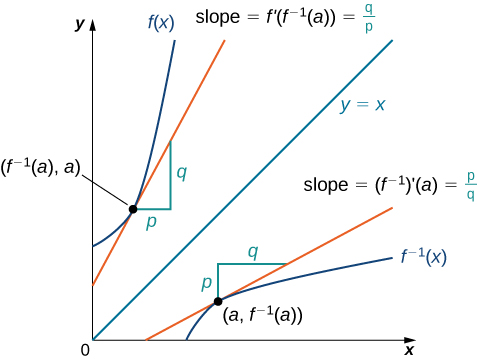
We begin by considering a part and its inverse. If \(f(ten)\) is both invertible and differentiable, it seems reasonable that the changed of \(f(x)\) is also differentiable. Figure \(\PageIndex{1}\) shows the relationship between a office \(f(x)\) and its inverse \(f^{−1}(x)\). Wait at the indicate \(\left(a,\,f^{−1}(a)\right)\) on the graph of \(f^{−1}(x)\) having a tangent line with a slope of
\[\big(f^{−1}\big)′(a)=\dfrac{p}{q}. \nonumber \]
This point corresponds to a indicate \(\left(f^{−1}(a),\,a\correct)\) on the graph of \(f(ten)\) having a tangent line with a gradient of
\[f′\big(f^{−1}(a)\large)=\dfrac{q}{p}. \nonumber \]
Thus, if \(f^{−1}(x)\) is differentiable at \(a\), so information technology must be the case that
\(\big(f^{−1}\big)′(a)=\dfrac{1}{f′\big(f^{−1}(a)\big)}\).
We may also derive the formula for the derivative of the inverse by outset recalling that \(x=f\big(f^{−1}(x)\big)\). So by differentiating both sides of this equation (using the chain rule on the right), we obtain
\(i=f′\big(f^{−1}(ten)\big)\big(f^{−1}\big)′(10))\).
Solving for \(\big(f^{−1}\big)′(x)\), nosotros obtain
\(\large(f^{−1}\large)′(10)=\dfrac{ane}{f′\big(f^{−one}(10)\large)}\).
We summarize this result in the post-obit theorem.
Let \(f(x)\) exist a part that is both invertible and differentiable. Let \(y=f^{−1}(x)\) exist the changed of \(f(x)\). For all \(x\) satisfying \(f′\big(f^{−1}(10)\big)≠0\),
\[\dfrac{dy}{dx}=\dfrac{d}{dx}\big(f^{−1}(ten)\big)=\big(f^{−1}\large)′(ten)=\dfrac{ane}{f′\big(f^{−one}(x)\big)}.\label{inverse1} \]
Alternatively, if \(y=thou(10)\) is the inverse of \(f(ten)\), then
\[g'(10)=\dfrac{i}{f′\big(g(x)\big)}. \label{inverse2} \]
Apply the changed role theorem to find the derivative of \(g(10)=\dfrac{x+2}{x}\). Compare the resulting derivative to that obtained by differentiating the function directly.
Solution
The changed of \(grand(ten)=\dfrac{x+2}{x}\) is \(f(x)=\dfrac{2}{10−1}\).
We will utilise Equation \ref{inverse2} and begin by finding \(f′(10)\). Thus,
\[f′(10)=\dfrac{−2}{(x−1)^ii} \nonumber \]
and
\[f′\large(chiliad(ten)\large)=\dfrac{−2}{(g(ten)−ane)^2}=\dfrac{−two}{\left(\dfrac{x+2}{x}−1\right)^2}=−\dfrac{x^ii}{2}. \nonumber \]
Finally,
\[g′(10)=\dfrac{1}{f′\big(thousand(x)\big)}=−\dfrac{2}{x^two}. \nonumber \]
We can verify that this is the correct derivative by applying the quotient rule to \(g(10)\) to obtain
\[thou′(ten)=−\dfrac{2}{x^ii}. \nonumber \]
Employ the inverse function theorem to find the derivative of \(g(ten)=\dfrac{1}{10+2}\). Compare the event obtained by differentiating \(g(x)\) directly.
- Hint
-
Use the preceding case equally a guide.
- Answer
-
\(g′(ten)=−\dfrac{1}{(10+2)^2}\)
Apply the inverse function theorem to observe the derivative of \(g(10)=\sqrt[3]{x}\).
Solution
The office \(g(x)=\sqrt[3]{x}\) is the inverse of the office \(f(x)=10^three\). Since \(g′(10)=\dfrac{one}{f′\large(g(x)\big)}\), begin past finding \(f′(x)\). Thus,
\[f′(x)=3x^ii\nonumber \]
and
\[f′\big(chiliad(10)\big)=3\big(\sqrt[3]{x}\big)^two=3x^{2/iii}\nonumber \]
Finally,
\[yard′(10)=\dfrac{1}{3x^{2/3}}.\nonumber \]
If nosotros were to differentiate \(thou(10)\) directly, using the power rule, we would first rewrite \(g(x)=\sqrt[three]{x}\) equally a power of \(x\) to get,
\[g(x) = x^{1/iii}\nonumber \]
So nosotros would differentiate using the power rule to obtain
\[g'(x) =\tfrac{1}{3}x^{−2/3} = \dfrac{1}{3x^{2/iii}}.\nonumber \]
Find the derivative of \(g(x)=\sqrt[5]{x}\) by applying the inverse function theorem.
- Hint
-
\(thousand(x)\) is the inverse of \(f(10)=x^v\).
- Answer
-
\(g(10)=\frac{1}{5}x^{−4/5}\)
From the previous case, we see that we can employ the inverse part theorem to extend the power rule to exponents of the class \(\dfrac{1}{north}\), where \(northward\) is a positive integer. This extension will ultimately let u.s.a. to differentiate \(x^q\), where \(q\) is any rational number.
The power rule may be extended to rational exponents. That is, if \(northward\) is a positive integer, then
\[\dfrac{d}{dx}\big(x^{1/north}\big)=\dfrac{ane}{n} x^{(1/n)−one}. \nonumber \]
Also, if \(due north\) is a positive integer and \(m\) is an capricious integer, then
\[\dfrac{d}{dx}\big(ten^{m/n}\large)=\dfrac{m}{n}x^{(thou/n)−1}. \nonumber \]
The function \(g(x)=x^{ane/northward}\) is the inverse of the role \(f(x)=x^n\). Since \(g′(x)=\dfrac{ane}{f′\big(1000(x)\big)}\), begin by finding \(f′(x)\). Thus,
\(f′(x)=nx^{northward−1}\) and \(f′\big(g(x)\big)=n\big(ten^{1/n}\big)^{n−1}=nx^{(n−1)/n}\).
Finally,
\(g′(ten)=\dfrac{i}{nx^{(north−1)/n}}=\dfrac{one}{n}x^{(1−n)/n}=\dfrac{one}{northward}x^{(ane/n)−ane}\).
To differentiate \(x^{one thousand/n}\) nosotros must rewrite it equally \((10^{1/due north})^yard\) and use the chain rule. Thus,
\[\dfrac{d}{dx}\big(x^{yard/n}\big)=\dfrac{d}{dx}\large((10^{1/n}\big)^m)=m\big(x^{1/n}\large)^{m−1}⋅\dfrac{1}{due north}x^{(1/due north)−1}=\dfrac{thousand}{n}x^{(m/n)−ane}. \nonumber \]
□
Discover the equation of the line tangent to the graph of \(y=x^{ii/three}\) at \(x=8\).
Solution
Beginning find \(\dfrac{dy}{dx}\) and evaluate it at \(x=8\). Since
\[\dfrac{dy}{dx}=\frac{ii}{3}ten^{−1/3} \nonumber \]
and
\[\dfrac{dy}{dx}\Bigg|_{ten=8}=\frac{1}{3}\nonumber \]
the gradient of the tangent line to the graph at \(10=8\) is \(\frac{1}{3}\).
Substituting \(10=viii\) into the original function, we obtain \(y=four\). Thus, the tangent line passes through the point \((8,4)\). Substituting into the point-slope formula for a line, we obtain the tangent line
\[y=\tfrac{i}{iii}10+\tfrac{iv}{3}. \nonumber \]
Observe the derivative of \(s(t)=\sqrt{2t+1}\).
- Hint
-
Use the chain dominion.
- Reply
-
\(southward′(t)=(2t+ane)^{−i/2}\)
Derivatives of Inverse Trigonometric Functions
We now turn our attention to finding derivatives of inverse trigonometric functions. These derivatives volition prove invaluable in the report of integration later in this text. The derivatives of inverse trigonometric functions are quite surprising in that their derivatives are actually algebraic functions. Previously, derivatives of algebraic functions accept proven to be algebraic functions and derivatives of trigonometric functions have been shown to exist trigonometric functions. Here, for the offset fourth dimension, we see that the derivative of a part need not be of the same blazon equally the original role.
Use the inverse function theorem to find the derivative of \(g(x)=\sin^{−1}x\).
Solution
Since for \(x\) in the interval \(\left[−\frac{π}{2},\frac{π}{2}\correct],f(ten)=\sin ten\) is the changed of \(g(10)=\sin^{−1}x\), begin by finding \(f′(10)\). Since
\[f′(ten)=\cos x \nonumber \]
and
\[f′\big(g(x)\big)=\cos \big( \sin^{−1}ten\large)=\sqrt{ane−10^2} \nonumber \]
we see that
\[m′(x)=\dfrac{d}{dx}\big(\sin^{−i}ten\large)=\dfrac{1}{f′\big(one thousand(x)\big)}=\dfrac{1}{\sqrt{ane−x^2}} \nonumber \]
Analysis
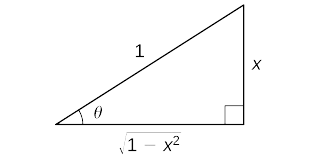
To see that \(\cos(\sin^{−i}ten)=\sqrt{one−x^ii}\), consider the following argument. Set \(\sin^{−1}x=θ\). In this case, \(\sin θ=x\) where \(−\frac{π}{2}≤θ≤\frac{π}{2}\). We brainstorm past considering the case where \(0<θ<\frac{π}{2}\). Since \(θ\) is an acute angle, we may construct a right triangle having acute bending \(θ\), a hypotenuse of length \(1\) and the side reverse bending \(θ\) having length \(ten\). From the Pythagorean theorem, the side adjacent to angle \(θ\) has length \(\sqrt{1−x^two}\). This triangle is shown in Figure \(\PageIndex{2}\) Using the triangle, we run into that \(\cos(\sin^{−1}x)=\cos θ=\sqrt{i−x^two}\).
In the case where \(−\frac{π}{2}<θ<0\), we make the observation that \(0<−θ<\frac{π}{2}\) and hence
\(\cos\big(\sin^{−1}ten\big)=\cos θ=\cos(−θ)=\sqrt{1−x^2}\).
Now if \(θ=\frac{π}{2}\) or \(θ=−\frac{π}{2},10=1\) or \(x=−1\), and since in either case \(\cosθ=0\) and \(\sqrt{1−x^2}=0\), nosotros have
\(\cos\big(\sin^{−1}10\large)=\cosθ=\sqrt{1−x^2}\).
Consequently, in all cases,
\[\cos\big(\sin^{−1}x\large)=\sqrt{1−x^two}.\nonumber \]
Apply the chain rule to the formula derived in Example \(\PageIndex{4A}\) to find the derivative of \(h(x)=\sin^{−ane}\large(yard(ten)\big)\) and use this outcome to discover the derivative of \(h(x)=\sin^{−1}(2x^3).\)
Solution
Applying the chain rule to \(h(x)=\sin^{−1}\big(g(x)\large)\), nosotros have
\(h′(x)=\dfrac{1}{\sqrt{1−\big(g(ten)\big)^2}}g′(x)\).
Now let \(g(x)=2x^3,\) then \(g′(ten)=6x^ii\). Substituting into the previous result, nosotros obtain
\(\begin{align*} h′(ten)&=\dfrac{1}{\sqrt{1−4x^6}}⋅6x^2\\[4pt]&=\dfrac{6x^2}{\sqrt{1−4x^6}}\cease{align*}\)
Use the inverse function theorem to find the derivative of \(g(x)=\tan^{−1}ten\).
- Hint
-
The inverse of \(g(x)\) is \(f(x)=\tan ten\). Use Example \(\PageIndex{4A}\) as a guide.
- Answer
-
\(g′(x)=\dfrac{one}{1+10^2}\)
The derivatives of the remaining inverse trigonometric functions may too exist found by using the inverse part theorem. These formulas are provided in the following theorem.
\[\begin{align} \dfrac{d}{dx}\big(\sin^{−1}x\large) &=\dfrac{i}{\sqrt{i−x^2}} \label{trig1} \\[4pt] \dfrac{d}{dx}\big(\cos^{−1}10\large) &=\dfrac{−i}{\sqrt{1−ten^two}} \characterization{trig2} \\[4pt] \dfrac{d}{dx}\big(\tan^{−1}x\big) &=\dfrac{i}{1+x^2} \label{trig3} \\[4pt] \dfrac{d}{dx}\big(\cot^{−1}x\big) &=\dfrac{−1}{1+x^2} \label{trig4} \\[4pt] \dfrac{d}{dx}\big(\sec^{−1}x\big) &=\dfrac{1}{|x|\sqrt{10^ii−one}} \label{trig5} \\[4pt] \dfrac{d}{dx}\large(\csc^{−1}10\large) &=\dfrac{−one}{|ten|\sqrt{ten^two−1}} \label{trig6} \cease{align} \]
Notice the derivative of \(f(ten)=\tan^{−1}(x^2).\)
Solution
Let \(g(x)=10^2\), so \(g′(10)=2x\). Substituting into Equation \ref{trig3}, we obtain
\(f′(x)=\dfrac{1}{ane+(10^ii)^two}⋅(2x).\)
Simplifying, we have
\(f′(10)=\dfrac{2x}{ane+x^4}\).
Find the derivative of \(h(ten)=x^2 \sin^{−ane}x.\)
Solution
By applying the product dominion, we have
\(h′(ten)=2x\sin^{−ane}x+\dfrac{1}{\sqrt{i−ten^2}}⋅ten^2\)
Find the derivative of \(h(ten)=\cos^{−1}(3x−ane).\)
- Hint
-
Employ Equation \ref{trig2}. with \(g(x)=3x−1\)
- Answer
-
\(h′(x)=\dfrac{−3}{\sqrt{6x−9x^2}}\)
The position of a particle at time \(t\) is given by \(south(t)=\tan^{−1}\left(\frac{ane}{t}\right)\) for \(t≥ \ce{1/ii}\). Notice the velocity of the particle at time \( t=i\).
Solution
Begin past differentiating \(s(t)\) in order to find \(v(t)\).Thus,
\(five(t)=due south′(t)=\dfrac{1}{1+\left(\frac{ane}{t}\right)^ii}⋅\dfrac{−1}{t^two}\).
Simplifying, nosotros accept
\(five(t)=−\dfrac{1}{t^2+1}\).
Thus, \(v(one)=−\dfrac{one}{2}.\)
Find the equation of the line tangent to the graph of \(f(10)=\sin^{−1}10\) at \(x=0.\)
- Hint
-
\(f′(0)\) is the slope of the tangent line.
- Answer
-
\(y=x\)
Central Concepts
- The inverse office theorem allows us to compute derivatives of inverse functions without using the limit definition of the derivative.
- We can utilise the inverse function theorem to develop differentiation formulas for the changed trigonometric functions.
Key Equations
- Inverse office theorem
\((f^{−one})′(10)=\dfrac{1}{f′\big(f^{−ane}(x)\big)}\) whenever \(f′\big(f^{−1}(x)\big)≠0\) and \(f(ten)\) is differentiable.
- Power rule with rational exponents
\(\dfrac{d}{dx}\big(x^{m/n}\large)=\dfrac{1000}{n}x^{(1000/north)−1}.\)
- Derivative of changed sine part
\(\dfrac{d}{dx}\big(\sin^{−i}x\big)=\dfrac{1}{\sqrt{1−x^2}}\)
- Derivative of inverse cosine function
\(\dfrac{d}{dx}\large(\cos^{−ane}x\large)=\dfrac{−1}{\sqrt{one−x^two}}\)
Derivative of inverse tangent office
\(\dfrac{d}{dx}\big(\tan^{−1}x\big)=\dfrac{i}{1+x^ii}\)
Derivative of inverse cotangent office
\(\dfrac{d}{dx}\big(\cot^{−i}x\large)=\dfrac{−one}{i+ten^ii}\)
Derivative of inverse secant role
\(\dfrac{d}{dx}\large(\sec^{−1}ten\big)=\dfrac{1}{|x|\sqrt{x^two−one}}\)
Derivative of inverse cosecant role
\(\dfrac{d}{dx}\big(\csc^{−1}10\large)=\dfrac{−i}{|ten|\sqrt{10^2−1}}\)
Contributors and Attributions
-
Gilbert Strang (MIT) and Edwin "Jed" Herman (Harvey Mudd) with many contributing authors. This content by OpenStax is licensed with a CC-BY-SA-NC 4.0 license. Download for free at http://cnx.org.
- Paul Seeburger (Monroe Customs College) added the 2d one-half of Example \(\PageIndex{ii}\).

Derivative Of F 1 X,
Source: https://math.libretexts.org/Bookshelves/Calculus/Book:_Calculus_%28OpenStax%29/03:_Derivatives/3.07:_Derivatives_of_Inverse_Functions
Posted by: rawlinsonhioname.blogspot.com
0 Response to "Derivative Of F 1 X"
Post a Comment